Wheat Straw vs Bamboo vs Plastic Tableware: Which Is Better?
As consumers and buyers worldwide pay more attention to sustainability, the choice of tableware materials has become more important than ever. Wheat straw, bamboo, and plastic are now the three most common options on the global market—but which one is truly better for your business and end customers?
In this article, we take a clear, practical look at wheat straw vs bamboo vs plastic tableware, focusing on real-world performance, safety, cost, and environmental impact. This guide is written for importers, wholesalers, private-label brands, and foodservice buyers who want reliable information—not marketing hype.
Understanding the Three Materials
Before comparing them side by side, it’s important to understand what each material actually is and how it’s used in tableware production.
What Is Wheat Straw Tableware?
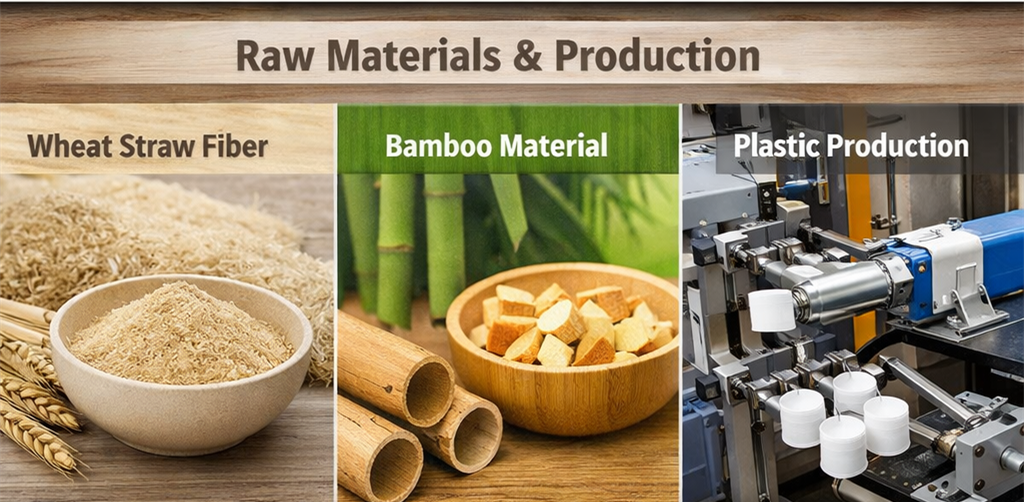
Wheat straw tableware is made from wheat straw fiber—the leftover stalks from wheat harvesting—combined with food-grade polypropylene (PP). Instead of being burned or discarded, the straw is reused, turning agricultural waste into functional, reusable products.
This material has gained strong popularity in recent years thanks to its balance of eco-friendliness, durability, and cost efficiency.
Key Characteristics of Wheat Straw Tableware
Made from renewable agricultural by-products
BPA-free and safe for food contact
Lightweight but resistant to cracking and breaking
Reusable and partially biodegradable
Easy to mass-produce with stable quality
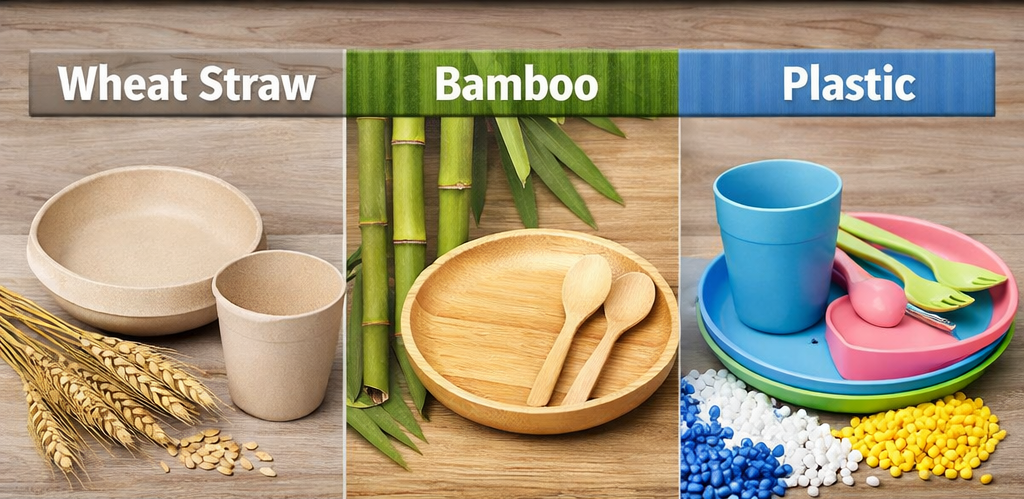
Common products: dinnerware sets, plates, bowls, cups, cutlery, kids’ tableware
What Is Bamboo Tableware?
Bamboo tableware is typically produced using bamboo powder or fiber combined with binders such as melamine resin. Bamboo grows quickly and is often associated with a natural, premium image, making it attractive for giftware and lifestyle brands.
However, bamboo tableware is not always as “natural” as it appears, especially when chemical binders are involved.
Key Characteristics of Bamboo Tableware
Made from fast-growing renewable bamboo
Natural texture and high-end appearance
Usually mixed with resin or melamine
More rigid and heavier than wheat straw products
Important note: Most bamboo tableware is not microwave-safe and may not be suitable for hot or oily foods.
What Is Plastic Tableware?
Traditional plastic tableware is commonly made from PP, PS, or melamine. It has dominated the market for decades due to its low cost, high durability, and design flexibility.
That said, plastic products are increasingly facing challenges from environmental regulations and shifting consumer preferences.
Key Characteristics of Plastic Tableware
Very durable and impact-resistant
Lowest production cost
Wide range of colors and designs
Made from non-renewable petroleum resources
Wheat Straw vs Bamboo vs Plastic: A Practical Comparison
| Feature | Wheat Straw Tableware | Bamboo Tableware | Plastic Tableware |
|---|---|---|---|
| Raw Material | Wheat straw fiber + PP | Bamboo fiber + resin | Petroleum-based plastic |
| Sustainability | High | Medium | Low |
| Food Safety | BPA-free, food-grade | Depends on binder | Depends on material |
| Durability | High, unbreakable | Medium | High |
| Weight | Lightweight | Heavier | Lightweight |
| Microwave Safe | Yes (PP-based) | Usually no | Some types |
| Cost Level | Medium | High | Low |
| OEM Customization | Excellent | Limited | Excellent |
Environmental Impact: Which Material Is Greener?
Wheat Straw Tableware
Wheat straw tableware makes use of agricultural waste, helping reduce straw burning and unnecessary waste. Compared to traditional plastic, it has a lower carbon footprint and fits well into reusable and low-waste product strategies.
Bamboo Tableware
Bamboo is renewable, but the processing stage can be energy-intensive. When melamine or resin is added, recycling and biodegradability become limited, reducing its overall environmental advantage.
Plastic Tableware
Plastic relies on fossil fuels and takes decades to decompose. Due to plastic reduction policies in many countries, its long-term outlook is becoming less favorable.
From a sustainability and scalability standpoint, wheat straw offers the most balanced solution.
Which Tableware Is the Best Choice for B2B Buyers?
Wheat Straw Tableware Is Ideal If You:
Sell eco-friendly or sustainable product lines
Need OEM/ODM services such as custom colors, logos, or packaging
Supply supermarkets, e-commerce sellers, or wholesalers
Want a balance between cost, durability, and green positioning
Bamboo Tableware Is Better If You:
Focus on premium, lifestyle, or gift markets
Sell lower volumes with strong design appeal
Do not require microwave-safe functionality
Plastic Tableware Still Fits If You:
Compete primarily on price
Serve markets with limited environmental restrictions
Focus on durability over sustainability storytelling
Why Wheat Straw Tableware Is Growing So Fast Globally
Wheat straw tableware is seeing strong growth in Europe, North America, Australia, and Japan, driven by:
Plastic reduction regulations
Rising demand for reusable tableware
Expansion of private-label eco brands
Retailers’ ESG and sustainability requirements
For importers and distributors, wheat straw products offer clear marketing stories, stable quality, and competitive pricing, making them well-suited for long-term brand development.
Final Verdict: Which Tableware Is Better?
There is no universal answer for every business, but for most modern B2B buyers:
Wheat straw tableware is the most practical and future-proof choice, offering a strong balance of sustainability, safety, customization, and cost control.
Bamboo tableware works well for niche premium markets, while plastic tableware continues to face increasing pressure worldwide.
Frequently Asked Questions
Is wheat straw tableware safe for food contact?
Yes. High-quality wheat straw tableware is BPA-free and meets FDA and LFGB food-contact standards.
Is bamboo tableware 100% natural?
In most cases, no. Bamboo products usually contain resin or melamine as binding agents.
Can wheat straw tableware replace plastic completely?
For most daily-use, household, and foodservice applications, it can.
SEO Keywords Used
wheat straw vs bamboo tableware
wheat straw tableware vs plastic
eco-friendly tableware materials
biodegradable tableware wholesale
sustainable dinnerware for importers